Latest News

How to Harvest Wild Mushrooms: A Guide to Foraging with Care

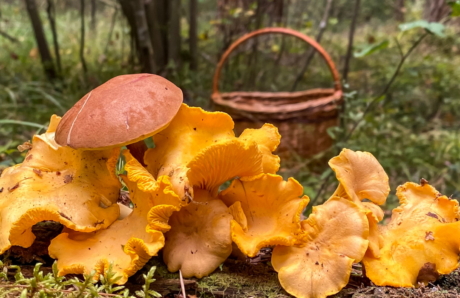
Mushroom foraging can be one of the most rewarding ways to spend time in the forest. After the rains, familiar trails can suddenly become full of oyster mushrooms, turkey tails, polypores, and other fungi emerging from trees, logs, and forest floors.

But harvesting mushrooms well involves more than simply finding them.

Good mushroom foraging begins with accurate identification, careful observation, and an understanding of how to harvest the fruiting body without unnecessarily disturbing the mycelium, tree bark, soil, or surrounding habitat.

Whether you are gathering mushrooms for food or medicine, a few simple practices can make harvesting cleaner, easier, and more respectful of the places you forage.

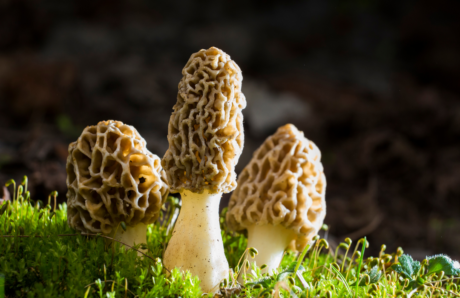
Foraging Morel Mushrooms

First: Know What You Are Harvesting

The most important rule of mushroom foraging is simple:

Never harvest or consume a mushroom unless you are certain of its identification.

There are toxic mushrooms, as well as many species with convincing lookalikes. Proper identification is essential before working with any wild mushroom.

Identification is particularly important with fresh, fleshy edible mushrooms. Mushroom fruiting bodies often appear after periods of rain, and timing, habitat, host trees, season, and physical characteristics can all help with identification.

A good field guide and experienced instruction are valuable tools, but neither should replace certainty before eating a wild mushroom.

Harvesting techniques will also vary depending on the mushroom. Fresh, fleshy mushrooms such as morels and chanterelles are generally softer and more delicate, while polypores and conks tend to be tougher and more firmly attached to their substrate. Knowing which type you are working with helps determine how you harvest, clean, and process it.

Useful Tools for Mushroom Foraging

You do not need complicated equipment to begin harvesting mushrooms.

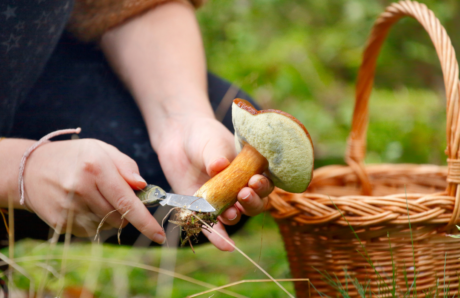
  • A sharp knife is one of the most useful tools to carry. Mushroom knives are often designed with a blade on one end and a small brush on the other, allowing you to harvest and clean mushrooms in the field. Some mushroom knives have curved blades, which can make working around certain fruiting bodies easier. You can also make a simple version yourself by attaching a small brush to a paring knife.
  • Pruning shears or clippers can be useful for tougher mushrooms and polypores.
  • An open basket is another useful piece of equipment. It protects delicate mushrooms better than a bag, provides airflow while you forage, and allows loose debris to fall away rather than collecting around your harvest. If you are carrying mature mushrooms, the open weave may also allow some spores to disperse as you move through the forest.
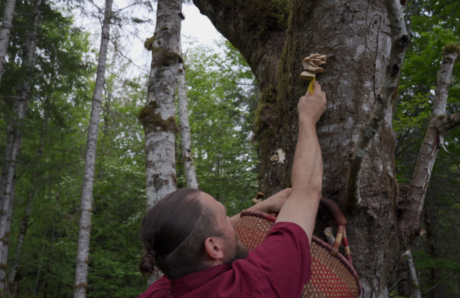
Foraging Oyster Mushrooms from Trees

Harvesting Mushrooms from Trees

When harvesting mushrooms growing from trees, protecting the bark is particularly important.

Oyster mushrooms, for example, may grow in large clusters from dead or declining hardwoods. Instead of simply tearing the cluster away, take a moment to look at how the fruiting body meets the tree.

Approaching from underneath can sometimes make harvesting easier because you can follow the natural angle at which the mushroom is emerging. If the cluster is already loose, you may also be able to gently rock or tease it away. The main thing is to avoid pulling away large pieces of bark with the mushroom. Removing bark can expose the mycelium underneath and unnecessarily disturb the substrate where the fungus is growing.

Of course, mushrooms do not always appear conveniently at eye level. If a cluster is growing overhead, you may need to get a little creative. One simple field technique is to securely attach your harvesting knife to a long stick so you can reach higher fruiting bodies. A loosely attached mushroom may even come free with a gentle nudge.

Whatever method you use, avoid damaging the tree just to reach a mushroom.

There will always be more mushrooms.

Harvesting Turkey Tail, Polypores, and Conks

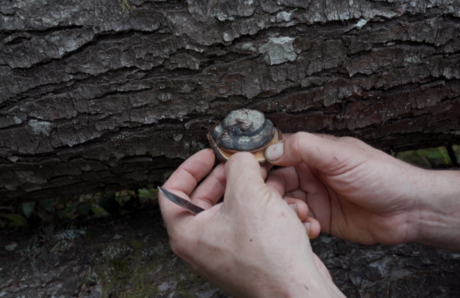
Turkey tail and other hard, tree-growing mushrooms often grow across fallen logs, decaying wood, or standing trees. Because they can be firmly attached, the goal is to remove what you need without taking unnecessary bark or wood with it.

Turkey tail can sometimes be pulled away by hand, but cutting or clipping it close to the attachment point generally creates a cleaner harvest. Pay attention to quality as you go. Fresher turkey tail usually has a lighter or whiter underside, while older fruiting bodies may begin to discolour or show signs of weathering.

With larger or harder polypores, work with the way the mushroom is attached rather than forcing it free. Some will release with gentle pressure, while others are better clipped or cut.

You also do not always need to harvest the entire fruiting body. Large perennial polypores often develop distinct layers or rings as they grow year after year, and the fresh outer edge is usually softer and easier to work with than the older, woody centre. In some cases, harvesting only a portion of the fresh growing edge allows you to gather usable material while leaving much of the mushroom intact.

When you encounter a large flush, consider harvesting from only part of it and leaving another section untouched. This is especially easy with abundant mushrooms such as turkey tail.

How to Harvest Wild Mushrooms A Guide to Foraging with Care (1)

Process Hard Mushrooms Quickly

Fresh polypores may feel surprisingly rubbery when first harvested. They do not necessarily stay that way.

As many hard mushrooms dry, they can become extremely tough and wood-like. That means processing them soon after harvesting can save considerable effort later. Cut fresh material into thin slices while it is still workable, then dry the pieces for later use in preparations such as decoctions. Waiting until the mushroom has completely hardened can make slicing much more difficult.

Cutting vs. Pulling Ground-Growing Mushrooms

Among mushroom foragers, one frequently debated question is whether mushrooms should be cut or pulled from the ground. Both techniques are used.

A mushroom can be cut cleanly near its base, or it can sometimes be gently pulled from the substrate at its natural breaking point.

If you pull the mushroom, you can trim away the dirty stem butt afterward and return that material to the forest. The important part is not aggressively disturbing the surrounding soil or mycelium.

Try both approaches and pay attention to how individual mushrooms release from the ground. Gentleness matters more than forcing one harvesting technique onto every species.

Picking wild mushroom

Cleaning, Sorting, and Storing Your Harvest

One of the easiest ways to make mushroom processing easier at home is to clean as you go.

Brush away moss, soil, pieces of bark, insects, needles, and other debris before placing a mushroom into your basket. One mushroom covered in dirt can quickly make everything else in the basket dirty too.

A little field cleaning saves a lot of work later.

Once you get home, give your harvest another look and remove any remaining soil, bark, damaged tissue, or other material you do not want to use.

For edible mushrooms, it can be useful to divide your harvest into roughly three groups:

  • fresh, intact mushrooms to store and use over the coming days
  • broken or slightly older mushrooms to cook sooner
  • mushrooms that are too deteriorated to use and should be composted or returned to the earth

Older mushrooms that are still usable may also be dehydrated or incorporated into broths, stocks, soups, or other cooked preparations.

And what about washing?

If you have done a good job cleaning as you go, you may not need to. A little remaining soil, bark, or forest debris can usually be brushed away.

If a mushroom really does need rinsing, it is generally best to use it soon rather than washing it and putting it back into storage.

The cleaner your mushrooms are when they come out of the forest, the less fuss there is later.

How Much Should You Harvest?

Mushroom harvesting is different in some ways from harvesting the leaves or roots of plants. The visible mushroom is the fruiting body of a much larger fungal organism. The mycelium itself remains in the substrate.

That does not mean harvesting should be careless. Whenever possible, allow mushrooms to mature enough to release spores before collecting them.

You can also leave areas of a large flush completely untouched rather than picking indiscriminately across the entire patch. There is rarely a reason to take everything you see.

Mushroom foraging

Pay Attention to the Mushroom and the Forest

How much you take matters, but so does how you harvest it. There is no single harvesting technique that works for every mushroom.

Some release easily with the lightest touch. Others need to be cut or clipped. Some are harvested only along their growing edge, while others are best left where they are. Learning to forage well means slowing down enough to notice those differences. Before pulling, cutting, or prying, look at how the mushroom is attached. Notice the condition of the bark, log, soil, or substrate underneath it. Feel how easily the fruiting body releases.

Good mushroom harvesting is partly technique, but it is also attention.

Know what you are gathering. Keep your harvest clean. Protect the substrate wherever possible. Take what you will actually use. And leave enough behind that the forest still looks abundant after you walk away.

Expand Your Understanding of Mushrooms with The Wild Rose Podcast

Has all this talk of foraging left you a little more curious about mushrooms?

Maybe you’re wondering what is happening beneath your feet when you walk through the forest, how those sprawling mycelial networks actually work, or what else mushrooms might have to teach us about medicine, ecology, and relationship.

There is a whole world down there to explore.

Join Yarrow Willard on The Wild Rose Podcast for The Living Network: Medicinal Mushrooms & Mycelial Wisdom, a conversation that wanders from medicinal mushrooms and their chemistry to mycelium, forest ecosystems, preparation, sustainability, and what can happen when we stop looking at mushrooms simply as remedies and start getting to know them as part of the living world around us.

Listen or watch on Spotify, Apple Podcasts, or YouTube.

Recent Posts

Rooted in Reciprocity: Herbalism, Conservation & the Plants We Depend On

From the Wild Rose Podcast with Dr. Susan Leopold, Executive Director of United Plant Savers What does it really mean to care for the plants we use? Herbalism brings us into relationship with plants in a very direct way. We learn about them, grow them, gather them, make medicine with them, and depend on them. […]
Spring Isn’t a Switch: Helping the Body Transition Gently

There’s a cultural expectation that spring arrives like a light switch. One day we’re tired and inward, the next we’re energized, motivated and ready to “detox.” But the body doesn’t work that way. Spring is not an instant awakening. It’s a transition. And for many people, that transition is messy, uncomfortable and misunderstood. The Awkward […]

Heart Medicine in the Dark Season: Emotional & Cardiovascular Support in Winter

Winter draws us inward. The days are shorter, the air is heavier, and for many of us, the heart feels a little more tender this time of year. In herbal medicine, the heart is never just a pump. It is the seat of emotional circulation, connection, rhythm and warmth. In the dark season, when external […]

January at Wild Rose: The Quiet Start to a New Year

At Wild Rose College, we believe winter isn’t a pause in learning, it’s an invitation to go deeper. While the world around us is rushing into resolutions and to-do lists, nature continues to rest. The plants are still holding their energy underground. The light is just beginning to return. And within this quiet, there’s space […]